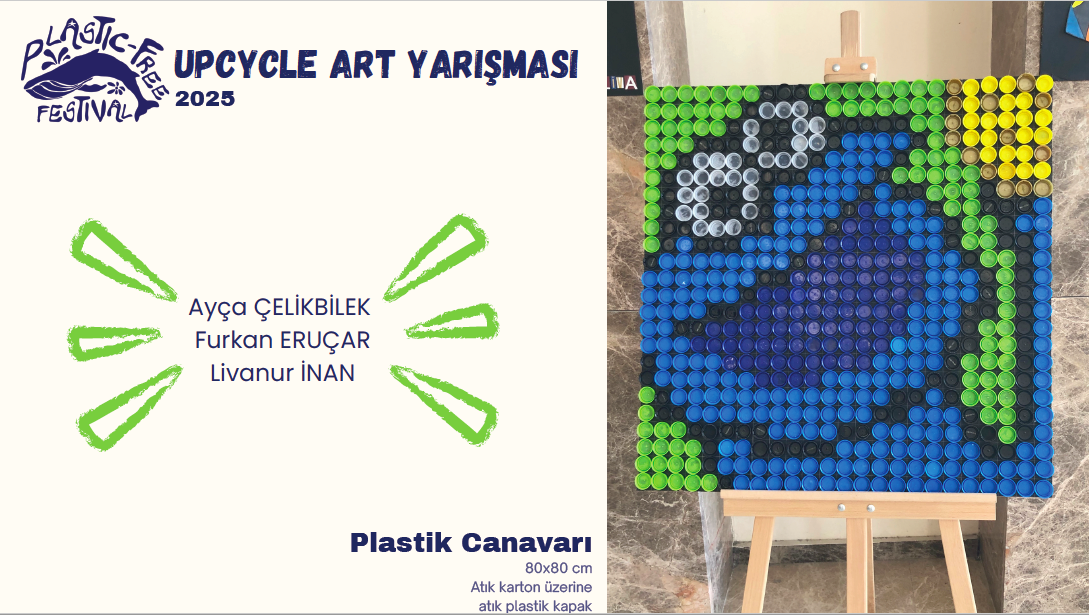
The upcycling artwork titled “Plastic Monster” designed by research assistants Ayça ÇELİKBİLEK and Furkan ERUÇAR from Istanbul Medeniyet University’s Sustainability Office and Livanur İnan, a member of the Sustainability Student Club, was awarded first prize in this year’s PlasticFree Fest 2025 Upcycle Art competition. The team received their award on Saturday, October 11, 2025, at the festival held at the Museum Gazhane.
The UpcycleArt competition, which aims to promote sustainable waste management practices, increase the reuse of waste, and encourage projects made from materials that can be upcycled, evaluated the entries based on specific criteria set by the jury. While the works were evaluated in terms of aesthetics and functionality, criteria such as the use of recycled materials, compliance with environmentally friendly design principles, and sustainability were prioritized. In addition, the jury carefully evaluated the projects’ innovation, social message-carrying power, and applicability. In this context, the competition went beyond being merely a design event, serving as a platform that encouraged young people to think about the environment and develop creative solutions. The team’s work, evaluated in these contexts, surpassed all competitors to receive the highest score and was deemed worthy of the first-place award.
From the Cookie Monster to the Plastic Monster
The 80×80 cm artwork, made entirely from waste materials, was designed using 576 plastic bottle caps on a waste cardboard base. Plastic caps, one of the most commonly encountered types of waste in daily life, were used in this project not only as a material but also as a carrier of an environmental message. The main purpose of the artwork was to draw attention to the importance of the concepts of “reuse” and “upcycling” which come before recycling in the waste hierarchy. In this respect, the project went beyond recycling and emphasized that waste can be given new meaning and transformed into artistic value through resource efficiency and environmental awareness.
The inspiration for the work was the Cookie Monster, an unforgettable children’s character from a bygone era. This character was transformed into a symbol confronting the modern world’s plastic consumption and renamed the “Plastic Monster.” Thus, the work became an ironic reference to both the material used and modern humanity’s dependence on single-use plastics. The accompanying explanatory note stated: “You had to tell your child about this character, which you see every day and consider normal, only through your memories, didn’t you? If we cannot find a solution to today’s waste problem, one day your child will also have to tell their child about a bird, butterfly, or flower they see every day only through memories…” This narrative powerfully reflected the idea of intergenerational environmental responsibility, which is the main theme of the work.
A Participatory Production Process and Social Impact
“The Plastic Monster” was created not only as a work of art but also as a live performance piece aimed at raising social awareness. The work was produced as a live performance in a public space during an environmental festival, where visitors could watch and participate. The caps were placed in a random order rather than sequentially, keeping the character formed by the artwork hidden for a while. This fictional curiosity involved the audience in the process, and as the artwork was completed, interaction increased through conversations about environmental awareness, turning the project into an environmental education initiative. Participants became part of the artwork by placing the appropriate colored caps they had in their hands on the painting together with the team. Throughout this process, more than 750 visitors were informed about the waste hierarchy and advanced recycling awareness. All of the caps collected were sourced from campus areas, school cafeterias, parks, and nearby businesses, making the artwork the product of a collective social production process.
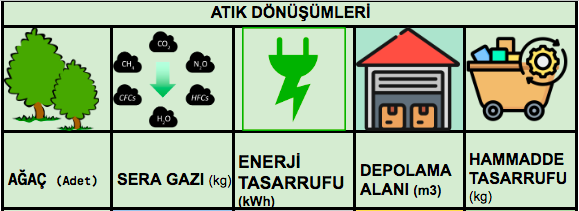
With the production of the artwork, a total of 1.44 kilograms of plastic waste was upcycled. Although this amount may seem small, according to environmental calculations, it saved approximately 8.3 kWh of energy and prevented 59 grams of carbon dioxide equivalent emissions. These figures demonstrated that individual efforts can make a tangible difference in combating climate change and encouraged people to take action. Furthermore, the materials used were not subjected to any chemical or thermal processing; thus, when the artwork reached the end of its life, it retained its recyclable quality. In this way, the project presented a dual-cycle example with both upcycling and recycling potential.
Art Transformed by Creativity
One of the most striking aspects of “The Plastic Monster” was the manual application of pixel art, a digital art language, using plastic caps. The team used creativity as a transformative force rather than technology by transferring the digitally created aesthetic structure onto a physical surface. This method also made a difference in that it showed that anyone could make creative productions from their waste without the need for advanced technology or expensive equipment. The work, which emphasized color contrasts, texture depth, and three-dimensional arrangement, also created a powerful visual impact. The background was designed with neon green and yellow covers to emphasize the blue tones of the character, creating both a dynamic composition and an energetic visual language that draws attention to environmental awareness. Thanks to its durable structure, the work is suitable for long-term exhibition, making it not only a festival piece but also a permanent awareness tool that supports environmental education.
Speaking on behalf of the team, Research Assistant Ayça ÇELİKBİLEK expressed the spirit of the project with these words:
“What we wanted to show with this work is that upcycling is an action that can be incorporated into everyone’s daily life, not just artists. Therefore, by choosing a material that we frequently come into contact with in our daily lives, we encouraged people to think about their own waste. On the other hand, we used simple methods in the production of the work instead of complex language or high innovation so that everyone could feel that they could upcycle their own waste. The Plastic Monster shows how even a simple material can be transformed into something meaningful with the right idea. Therefore, each cap in the work is both a color and a unit of awareness. Our goal is to multiply this awareness.”
Livanur İNAN, our third-year Health Management student who participated in the project, described the project process with the following words:
“This project process was both an educational and enjoyable experience for me. I saw that collecting, sorting, and washing the lids required both effort and patience. This process taught me how even a small thing can become a meaningful work of art when valued, and to evaluate every material with a focus on reuse. Throughout the project, I felt the importance of teamwork, the power of solidarity, and the joy of creating. Seeing the final product was like receiving the reward for all the effort—it was truly rewarding.”
This competition victory stands as a tangible demonstration of Istanbul Medeniyet University’s sustainability vision and the creativity of its young researchers. The work, prepared by the Istanbul Medeniyet University Sustainability Office and the IMU Sustainability Student Club, stands out as part of the university’s recent environment and climate-focused initiatives. Research assistants within the Office and members of the Sustainability Student Club continue to produce innovative projects in the areas of sustainable production, recycling, upcycling, and the environment together with our students.