
The Ministry of Environment, Urbanization, and Climate Change has designated February as “Electrical, Electronic, and Metal Waste Month” as part of the Zero Waste movement, with the aim of drawing attention to a different type of waste each month. Within this scope, a series of educational and practical activities were held at our university during February to raise awareness about the environmental impacts of electronic waste, its proper management, recovery processes, and reduction.
As part of the program organized by the Sustainability Office, four separate seminars were held, open to our students, academic and administrative staff, as well as the general public. The seminars were given by Ayça ÇELİKBİLEK, a research assistant at the Sustainability Office. The seminars emphasized that electronic waste has become a rapidly growing environmental problem on a global scale, with the amount of e-waste increasing significantly each year, particularly due to rapid technological renewal and short product lifecycles. Following the seminars, an “Electronic Waste Examination and Disassembly Workshop” was organized in collaboration with Pulsec.
On Saturday, February 7, 2026, the first seminar titled “E-Waste: What Is It?” was held, providing participants with basic information about the scope of electrical and electronic waste. ÇELİKBİLEK stated that computers, mobile phones, small household appliances, batteries, and various electronic equipment fall into the category of e-waste after their useful life has ended. She explained that if this waste is disposed of in an uncontrolled manner, it can pose serious risks to the environment and public health due to the heavy metals and chemical components it contains. She stated that substances such as lead, mercury, cadmium, and brominated flame retardants can contaminate soil and water resources when disposed of improperly, which can have long-term negative effects on ecosystems. Noting that approximately 62 billion kg of e-waste was generated worldwide in 2022, ÇELİKBİLEK stated that this figure is expected to reach 82 billion kg by 2030. Despite this, she noted that 81 countries have e-waste policies, but most of them focus on extended producer responsibility, emphasizing that less than half of these countries have a transformation goal in their policies.
The seminar emphasized that e-waste is not merely an environmental issue, but also a significant source of secondary raw materials when managed properly. It was stated that electronic devices contain valuable metals such as copper, aluminum, gold, silver, and rare earth elements, and therefore recovery processes are of great importance both environmentally and economically. Highlighting that 1 ton of electronic waste contains 100 times more gold than 1 ton of ore, ÇELİKBİLEK stated that e-waste is referred to as “urban mining” due to this characteristic.
On Monday, February 9, 2026, a seminar titled “E-Waste Recycling” was held, focusing on e-waste recycling. ÇELİKBİLEK stated that e-waste, referred to as urban mines, has an economic impact of $37 billion worldwide, emphasizing that if this waste is not recycled, both this value and new raw material sources will be lost, and if it is not disposed of using the correct disposal method, the soil and water cycle, and therefore human health, will be negatively affected by toxic components. However, it was stated that recycling rates remain low in some regions due to the lack of necessary physical infrastructure, legal infrastructure, and consumer habits. Attention was drawn to the fact that the emergence of informal channels as a result of the lack of physical infrastructure could make this waste, which contains toxic components such as heavy metals, even more harmful. Stating that all actors, namely national governments, businesses, civil society, and consumers, have important roles to play in establishing a proper e-waste recycling system, ÇELİKBİLEK explained these roles and outlined what could be done within the cycle to improve the recycling process. At the end of the seminar, successful examples of countries and companies in e-waste recycling were examined.
The seminar titled “E-Waste: Reuse and Repair” held on Wednesday, February 11, 2026, focused on extending the life of electronic products and reuse. The seminar covered in detail what needs to be done to extend the life of electronic products and approaches to reuse. ÇELİKBİLEK began her remarks by stating that recycling is often discussed in the waste management process, but that recycling is at the bottom of the waste hierarchy and that priority should be given to refusal and reduction. She then addressed the importance of repairability in reducing e-waste. While it was noted that most e-waste is generated in developed countries, the culture of repair is more prevalent in developing countries, and it was emphasized that this situation is a result of the cheapening of products due to technological advances and the influence of culture. It was also discussed that digital lock applications in some products lead to them becoming waste even if they are still functional. At the end of the seminar, options such as repair cafes and websites containing repair guidelines that could be preferred to minimize e-waste production were examined.
On Thursday, February 12, 2026, the seminar titled “E-Waste: Reduction” addressed practices related to reducing electronic waste and whether an e-waste-free society is possible. ÇELİKBİLEK began the seminar by stating that the first stage of the waste management process is refusal, and expressed that technology and social capital encourage individuals to constantly buy the latest products, which increases the amount of e-waste generated. She explained that research has shown that a quarter of the e-waste found in landfills is in working condition and does not even need to be repaired. Therefore, she stated that the priority should be to avoid purchasing unnecessary electronic items, and that electronics that can be used after repair should be repaired or donated. She pointed out that in recent years, some companies have been running campaigns such as offering discounts or gifts on new products in exchange for old electronic products, and that consumers should be aware of these collection points.
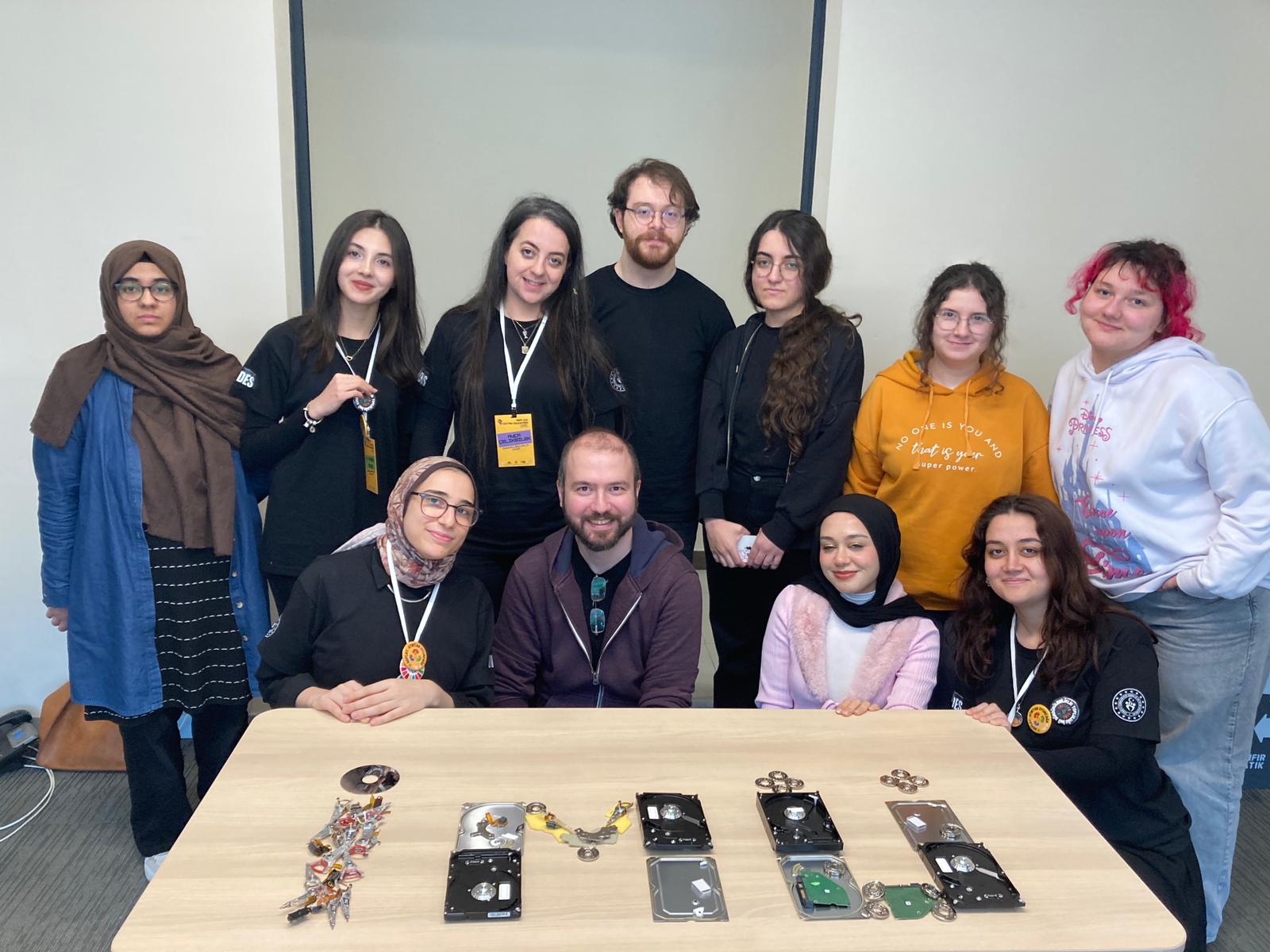
Following the seminar series, an “Electronic Waste Examination and Disassembly Workshop” was held on Tuesday, February 17, 2026, to allow participants to gain hands-on experience with the subject. The workshop, held in collaboration with Pulsec and hosted by the Sustainability Office, was led by Caner G. YALIN. During the workshop, various electronic devices that had reached the end of their useful life and become e-waste at our university were dismantled and examined, and participants had the opportunity to observe the internal components of the devices with guidance. During the workshop, where each participant dismantled a device, the circuit boards, cables, metal parts, and plastic components of the electronic devices were examined; information was provided on how different materials are separated and how the recovery processes are carried out. Suggestions were also made not only on recycling but also on what parts of electronic devices that have become waste can be reused and how these parts can be upcycled. This application clearly demonstrated that electronic waste is not just waste, but can be an important resource when evaluated using the right methods.
The seminars and hands-on workshops raised awareness among the university community about the environmental impacts of electronic waste, while aiming to promote proper waste management habits among participants.


