
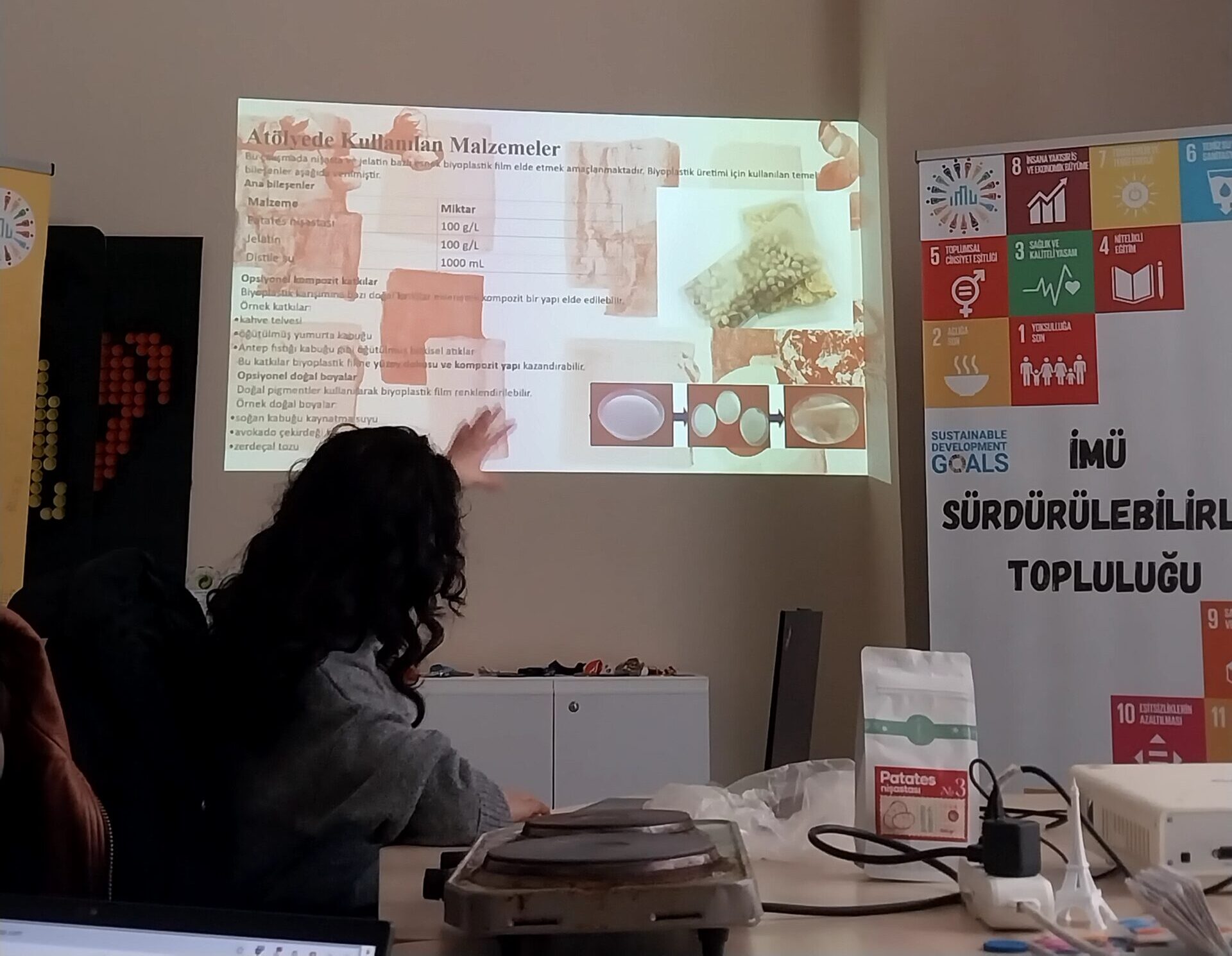
Istanbul Medeniyet University Sustainability Club, in collaboration with the Sustainability Office, organized a comprehensive Bioplastic Production Workshop for club members on March 7, 2026. The event, which lasted approximately two hours, was led by IMUSUS alumnus MSc. Bioengineer Yağmur ÖNER and provided participants with both theoretical knowledge and practical experience.
The workshop began with information on the environmental impacts of petroleum-based plastics and the problems created by waste that does not decompose in nature. ÖNER stated that these plastic materials, preferred for their low cost, lightness, ease of shaping, and durability, have become a major environmental problem because they remain in nature for a long time. Referring to the garbage patches in the ocean known as the 8th continent, ÖNER stated that when plastic breaks down, it turns into microplastics, and research has found that microplastics are now present in soil, food, and even breast milk. She emphasized that plastic pollution is a serious global problem and stated that, for this reason, the search has begun for alternative materials that possess the properties of plastic but are more environmentally friendly. At this point, she noted that bioplastics have significant potential, particularly because they are derived from biological sources and are biodegradable.
Continuing her presentation with the weaknesses in current bioplastic research and predictions about the future of bioplastics as a material, ÖNER stated that in addition to being used as packaging material, medical and biomedical material, and 3D printing raw material, and with product innovations in recent years, it has also begun to be used in different fields such as textiles, art, and gastronomy.
Following the theoretical briefing, the workshop moved on to the application phase, where participants produced a flexible starch and gelatin-based bioplastic film. Led by ÖNER, the production process involved heating the mixture of materials to a specific temperature to initiate the polymerization process, then pouring it into different Petri dishes to create various shapes. Participants also learned about optional composite additives and the natural dyeing process, developing some samples with their own creativity to create different textures and visual effects. This stage allowed them to observe the physical properties of the material and explore creative design possibilities.
During the workshop, the drying time, flexibility, and durability of bioplastics were observed. Participants prepared their own bioplastic samples, experiencing all stages of the process and learning the technical details of the production process. The workshop went beyond the transfer of theoretical knowledge, offering hands-on learning and the opportunity to gain experience.
IMUSUS academic advisor Research Assistant Ayça ÇELİKBİLEK emphasized the importance of IMUSUS graduates, who are active in green jobs after graduation, sharing their experience and knowledge gained in their professional lives with club members. She noted that graduates sharing their R&D and field experience, as well as new developments in technology, would broaden the perspective of the club’s project teams in their project designs. perspective in project design. She stated that the workshop enabled project leaders to gain knowledge and practical skills in bioplastic production and sustainable material design that they can apply in their own projects.
The Sustainable IMU team stated that they will continue to guide participants on environmentally friendly production methods, sustainable materials, and innovative solutions through such workshops. They aim to enhance project quality and strengthen the culture of sustainability by enabling club members to both gain knowledge and acquire practical experience through such events held within the university.


