Istanbul Medeniyet University Sustainability Office and the Sustainability Club continued to work towards sustainable development goals by organizing and supporting events as part of “World Environment Day” engaging with various segments of society. Our university contributed to extending the culture of sustainability beyond campus boundaries through social responsibility projects led by the sustainability team, partnerships developed with local governments, and representation on international platforms.
The initiatives organized this year as part of World Environment Day activities aimed not only to educate participants on waste management but also to make them active participants in the solution, by integrating the circular economy approach into daily life practices. In events catering to all age groups, from children to adults, concepts such as recycling, upcycling, reuse, zero waste, and the protection of biodiversity were conveyed through practical experiences.
A Story That Sprouted from Waste in Maltepe: The “Make Your Own Calendar” Workshop
As part of the “Transformation Workshops” Social Responsibility Project, carried out under the sustainability cooperation protocol signed between Maltepe Municipality and our University, the “Make Your Own Calendar Workshop” was held on Friday, June 5, 2026, at the Maltepe Çocuk Tarım Park as part of World Environment Day activities.
In the workshop led by students from the IMU Sustainability Club, seed calendars were produced using handmade seed-embedded paper—made from waste paper using traditional methods in previous workshops—and calendar bases created via 3D printing technology using filaments made from recycled PET bottle waste generated on our campuses. Participants, who experienced the different stages of the circular economy in a single event, gained hands-on experience with both upcycling and recycling processes and personalized their calendars using dried flowers. One of the most meaningful aspects of these calendars—which are designed to be buried in the ground and composted after the month ends—is that the seed-embedded paper allows various flower seeds to sprout when buried. In this way, while extending the life cycle of waste, the initiative also contributes to supporting the urban ecosystem and biodiversity.
Throughout the event, participants had the opportunity to learn about the waste hierarchy, the differences between recycling and upcycling, resource efficiency, and the principles of sustainable design.
Circular Economy and Zero Waste Awareness at the Kadıköy Environment Festival
On June 6–7, 2026, our sustainability teams contributed to the Kadıköy Environment Festival, organized by the Kadıköy Municipality in Özgürlük Park, by setting up a booth and hosting workshops. At the festival, which was held under the theme of “circular economy” the waste management and circular economy initiatives carried out by our Sustainability Office were presented to visitors. Throughout the festival, which featured our Sustainability Club students, alumni, and Sustainability Office research assistants, it was emphasized that the applications developed at our university not only generate environmental benefits but also create value through their educational, social participation, and social responsibility dimensions.
One of the projects introduced at the festival, the “RePlay: From Waste to Toy Social Responsibility Project” led by Sustainability Office research assistant Ayça ÇELİKBİLEK and Sustainability Club president Livanur İNAN, served as an example of reevaluating waste in creative and socially beneficial ways. The project, which involves using filaments produced from recycled PET bottles collected on our campuses in 3D printing technologies and designing educational toys through the upcycling of medicine bottle caps collected from hospitals, attracted great interest from both children and adults.
Over the duration of the festival, the toys produced as part of the project were showcased, and children were given the opportunity to experience them firsthand. While playing with the toys, children were explained—using age-appropriate methods—the processes the materials went through and why they needed to be reused. In this way, children had the opportunity to learn about sustainability through play and also experienced firsthand how the materials they typically throw away in trash bins are transformed.
Also, throughout the festival, environmental education was provided to children through the “Waste Sorting Game” designed and produced by our Sustainability Office to raise awareness about zero waste and waste sorting. In the game, which drew great interest from the children, participants learned hands-on which bins to use for glass, plastic, metal, paper, and organic waste, while discovering the differences between recyclable and non-recyclable waste. The importance of proper sorting—the foundation of the zero-waste approach—for the effectiveness of recycling systems was emphasized.
The event highlighted that fostering eco-friendly behaviors in children at an early age plays a critical role in long-term societal transformation, and aimed to support the learning process through fun experiences.
A Collaborative Artwork Made from Plastic Bottle Caps
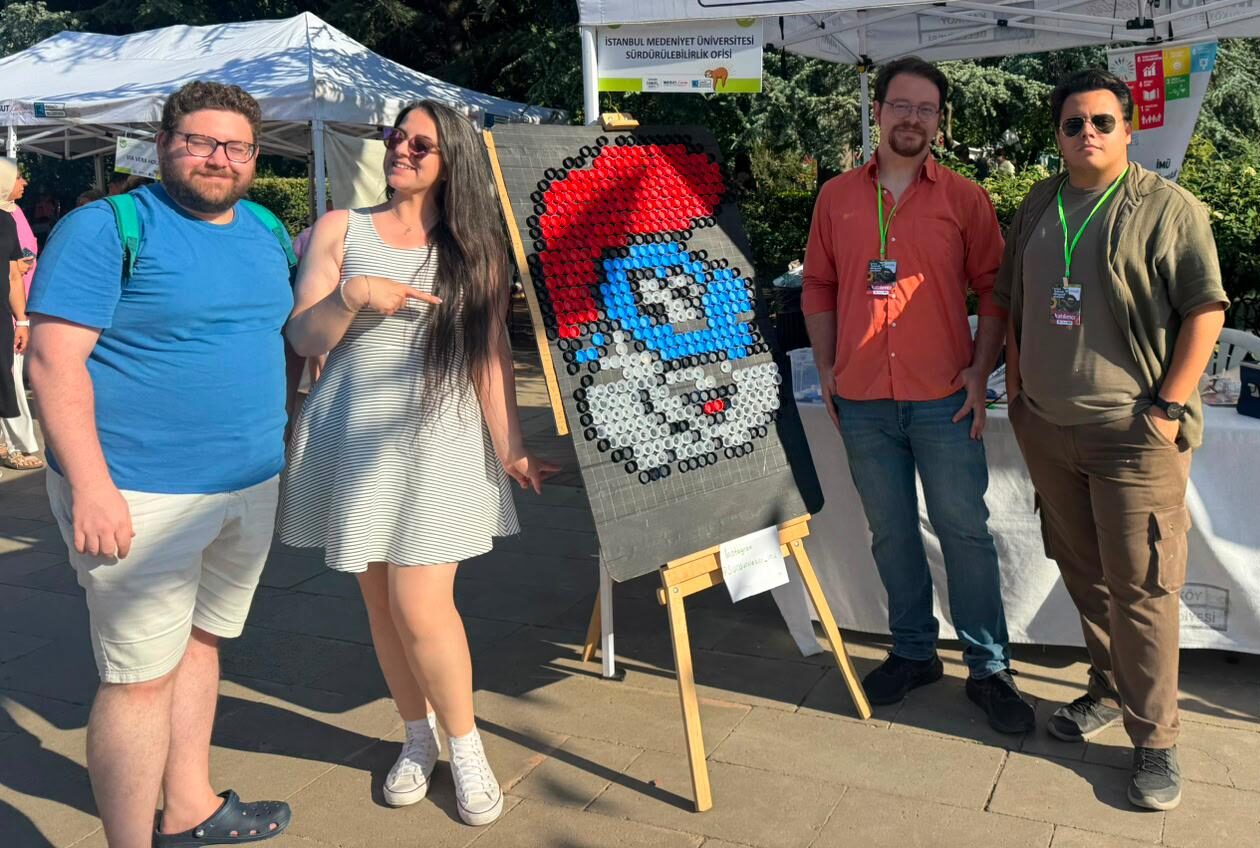
Another project carried out throughout the festival was a pixel art painting created through the collective effort of participants, part of the Sustainability Office’s now-traditional upcycling initiatives. Created using plastic bottle caps and waste cardboard collected from supermarkets, the project served as a compelling example of how waste can be reimagined through creative methods. Visitors of all ages contributed to the artwork, participating in a collective art-making process centered on sustainability.
Through this initiative, participants were informed about the 3R approach (Reduce–Reuse–Recycle), which emphasizes that the primary focus in waste management should not be solely on recycling; rather, it should involve reducing consumption, reusing products, and addressing recycling as part of a comprehensive strategy.
We Represented Our University at the Zero Waste Forum
Research Assistants Ayça Çelikbilek and Furkan Eruçar from our Sustainability Office represented our university at the Zero Waste Forum, held at Atatürk Airport between June 5–7, 2026, under the patronage of Mrs. Emine Erdoğan and coordinated by the Zero Waste Foundation.
The forum, which brought together national and international stakeholders, addressed the role of zero-waste practices in combating climate change, circular economy policies, resource efficiency, sustainable production and consumption models, and innovative waste management approaches. Throughout the three-day program, experts, academics, government representatives, and civil society organizations from various countries around the world shared successful case studies, while participants had the opportunity to exchange experiences and knowledge.
Our team, which participated in the forum on behalf of our university, not only closely followed international initiatives in the field of sustainability but also established important contacts for potential future joint projects and academic collaborations. It is anticipated that the knowledge and experience gained from the forum will provide new perspectives for the sustainability initiatives being carried out at our university.
Working Together for a Sustainable Future
Istanbul Medeniyet University approaches sustainability not merely as an environmental responsibility, but as an integral part of its education, research, social contribution, and corporate governance processes.
All these initiatives, carried out as part of World Environment Day, have contributed to raising individuals’ environmental awareness, reusing waste as a resource, and promoting sustainable living habits across all segments of society.
Thanks to our students’ sense of responsibility, the support of our academic and administrative staff, and the contributions of our stakeholders, we believe that a sustainable future can only be built by working together; we continue our efforts to ensure that the transformation beginning on our campuses spreads throughout society.