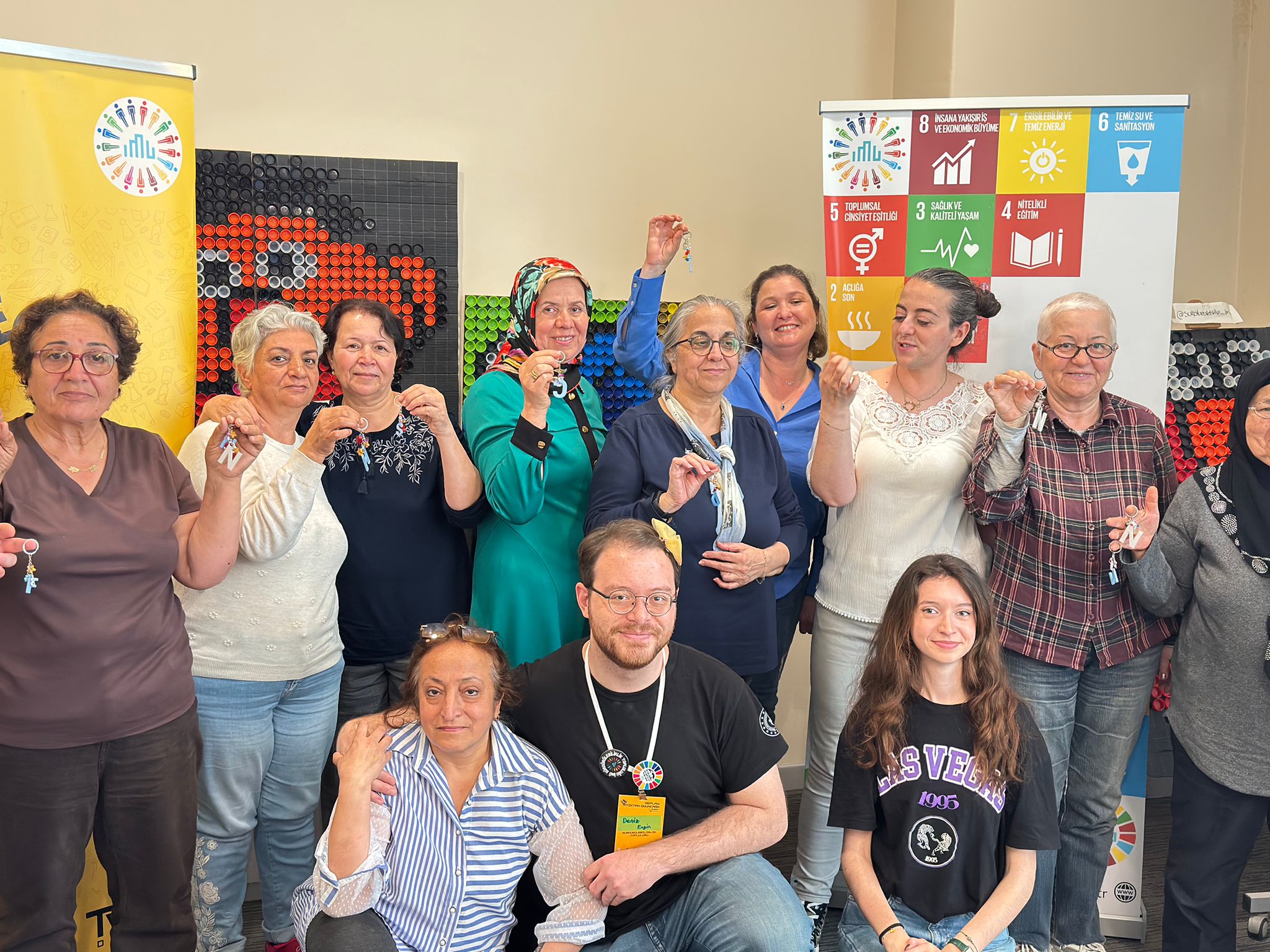
The fifth workshop of the “Transformation Workshops” social responsibility project, carried out in collaboration with Maltepe Municipality, was hosted by our university. The event, held at the Sustainability Office of Istanbul Medeniyet University, addressed the recycling of plastic waste, circular economy practices, sustainable production models, and on-site recycling technologies. Participants received theoretical training and also gained hands-on experience by participating in practical production processes, learning how waste can be transformed into a valuable resource.
During the theoretical training part of the event, Ayça ÇELİKBİLEK, a research assistant at the Sustainability Office, provided participants with information on the structure of plastic materials, the types of plastics used in daily life, and how to read the codes on product packaging for these types. Sharing insights on the applications of plastics, recycling processes, and the fact that each type of plastic requires different conversion methods, ÇELİKBİLEK also discussed quality losses in recycling processes, physical changes in plastics during reuse cycles, and the importance of sustainable material management. Thus, participants had the opportunity to address not only waste separation but also the life cycle of plastics and resource management from a holistic perspective.
Following the theoretical training, information was provided about the PET recycling workshop—one of the on-site recycling workshops established on our campus by the Istanbul Medeniyet University Sustainability Office. Furkan ERUÇAR, a research assistant at the Sustainability Office, introduced participants to the PetMachine system used in the workshop and demonstrated hands-on how PET bottles are recycled and turned into filament. It was emphasized that this system, developed by drawing inspiration from open-source production technologies, contributes to the local-scale revaluation of plastic waste, increased resource efficiency, and reduced waste generation. During the hands-on activity conducted with the participants, filament was produced from waste PET bottles, allowing them to directly experience how waste can be incorporated into a new production process.
Later in the workshop, participants were introduced to 3D printing technologies. Information was provided on how the produced filaments can be used in 3D printers, how digital production processes relate to sustainable production models, and the process of transforming recycled raw materials into new products; products with a circular design produced by the Sustainability Office using this method were showcased. It was emphasized that waste can be transformed into new economic and functional products through the combined use of local production, open-source technologies, and a circular economy approach. This allowed participants to explore the relationship between sustainability, technology, and design through practical examples.
In the practical part of the workshop, participants designed their own keychains using letters made from recycled PET bottles, beads prepared by repurposing short filament pieces left over from production processes, and leftover materials collected from homes. Each participant’s ability to personalize their own design demonstrated how creative production processes can be integrated with sustainability initiatives. Thus, participants not only learned about recycling processes theoretically but also had the opportunity to experience upcycling, reuse, creative repurposing, and sustainable design practices.
Through the workshops held as part of the “Transformation Workshops” project, the goal is not only to sort waste but also to give it new value by incorporating it into creative production processes. In this way, participants have the opportunity to experience the concept of sustainability not merely as a theoretical idea, but as a practical model of production and consumption in their daily lives.
Information about future workshops in the project is available via the Sustainability Office’s social media account.