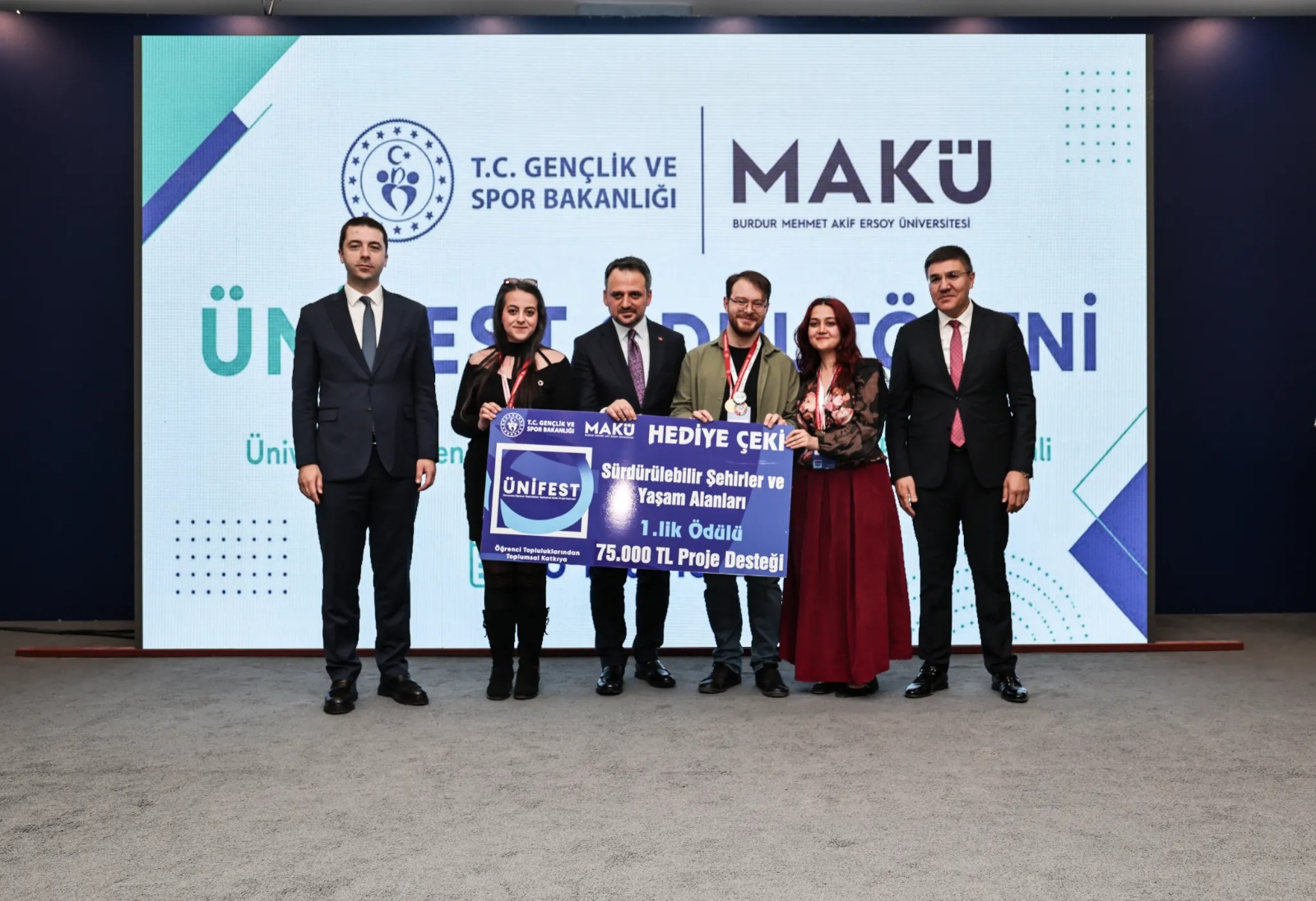
The IMU Sustainability Club returned with first place from the final round of the University Student Clubs Social Contribution Project Competition (ÜNİFEST), hosted by Burdur Mehmet Akif Ersoy University from May 5–8, 2026. Organized in collaboration between the Ministry of Youth and Sports of the Republic of Turkey and Burdur Mehmet Akif Ersoy University (MAKÜ) to raise university students’ awareness of social responsibility and enable them to implement innovative projects, the competition’s “Sustainable Cities and Living Spaces” category featured the project “BioBlitzİMÜ: Participatory Biodiversity Monitoring Model” in the “Sustainable Cities and Living Spaces” category. The team, consisting of club members Şirin Beyza ÖZBEY and Bedrihan YALTA, was joined by the club’s academic advisor and Research Assistant at the Sustainability Office, Ayça ÇELİKBİLEK.
During the final presentation held on May 6, 2026, the presentation team first provided information about the club. They then discussed both the scientific methodology of the BioBlitzİMÜ project—specifically regarding biodiversity mapping and species identification—and the value added by the “citizen science” approach adopted during observations conducted in Validebağ Grove. The team highlighted that the project contributed to society through environmental education provided to over 25,000 people in collaboration with digital eco-observers, and emphasized that the scientific outputs serve as an important and up-to-date decision-support mechanism for conservation decisions.
Under the academic leadership of our university’s research assistant Ayça ÇELİKBİLEK, the BioBlitzİMÜ project has been supported since 2021 by seven expert volunteers from various fields, including urban planning, ornithology, malacology, mycology, limnology, and geology. Conducted using the “citizen science” method, the project includes at least one observation event every season and is open to the general public as well as our university students. While observations and data entry are carried out by participants and students from the IMU Sustainability Club, species identification during observations and subsequent species identification studies are conducted by different groups of experts. During the presentation, it was emphasized that this multidisciplinary structure makes a significant contribution not only to mapping a single species but to mapping the entire ecosystem.
Noting that all data recorded during observations is transferred to a digital, open-access database, the team emphasized that this feature ensures the project provides open-access, up-to-date data not only to Istanbul residents and city administrators but also to all national and international researchers. It was noted that the data provided through the project is already being utilized in initiatives such as the “Unveiling” project at the University of Florence, which investigates the impact of the perception of beauty on the desire to protect butterflies.
Highlighting the importance of public awareness in biodiversity and natural area conservation, the team emphasized that the primary target audience for the project—designed around the motto “You can’t protect what you don’t know”—is therefore the people of Istanbul. It was noted that participants’ species identification skills improved significantly following the workshop. The project team explained that another key outcome of the project was the development of ecosystem and environmental education materials during the project period. They noted that families bringing their young children to the observation sessions inspired them to create educational materials that would make biodiversity education accessible to even younger children. In this context, it was stated that “Nature Detectives” a simplified and gamified version of the TürSay activity, was used as an environmental education material by over 250 children at Validebağ Grove, as well as Kadıköy Özgürlük Park and Bakırköy Sanatçılar Park.
Regarding the “Koru Cards” prepared for 2026, the team noted that they contain information not only about species found in the forest but also about the most commonly seen species across Istanbul, as well as tips for distinguishing between the most frequently confused species. They emphasized that with these cards, city dwellers can identify species on their own even outside of observation times.
Through the 9 observation events held to date as part of the BioBlitzİMÜ project, 34 participants have recorded 1,192 observations, and these observations have helped map 352 species, including invasive species such as the green parakeet and sensitive species. Through these observations, 550 people have gained direct awareness and expert knowledge regarding biodiversity; meanwhile, content published on digital platforms has raised awareness among more than 25,000 digital eco-observers.
The IMU Sustainability Club and BioBlitzIMU project, which won the jury’s approval with its vision of environmental sustainability and model of social participation, successfully represented our university’s sustainability goals on a national platform.
At UNIFEST, where over 450 university club projects from across Turkey competed, 100 student club projects from 59 universities advanced to the finals across 10 themes. The 30 most successful student groups, whose projects were deemed worthy of support during the final presentations, were eligible to receive a share of the total 1.5 million TL in grant funding provided by the Ministry of Youth and Sports of the Republic of Turkey.